Drawn in 1963
Nassau-Suffolk is the most segregated purely suburban region in the United States. Its district lines were constitutionally entrenched the same year its first desegregation order arrived.


In September 1963, Black families in Malverne pulled their children out of the elementary schools the district had assigned them to and sent them instead to Freedom Schools set up in local churches. The State Education Commissioner had ordered Malverne to integrate three years earlier. The district had not complied.
Nassau County’s state senator, Norman Lent — later a U.S. Congressman representing Nassau County for more than two decades — introduced legislation in Albany to ban the busing that integration would require.
Two months later, New York voters approved a constitutional amendment that made the district lines around them permanent.
The Map
The Nassau County and Suffolk County region is the most segregated purely suburban region in the United States:
Ninety percent of Long Island’s Black residents live in twenty percent of its communities.
Two-thirds of Long Island’s cities, towns, and villages remain less than one percent Black.
The three most racially isolated school districts for children of color in New York State, outside New York City, are all on Long Island: Roosevelt and Hempstead in Nassau County, and Wyandanch in Suffolk County.
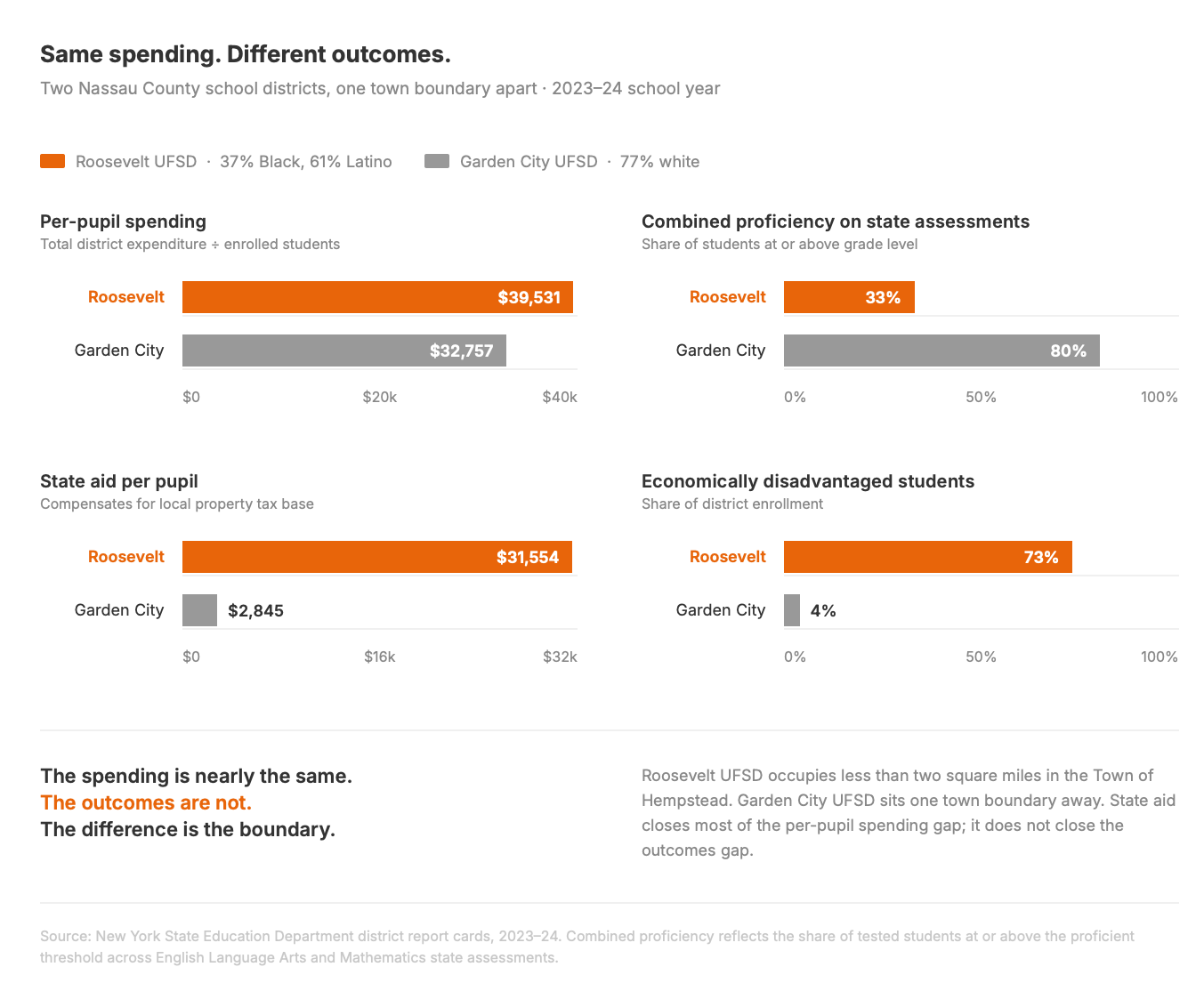
Nassau County has fifty-six separate school districts in 453 square miles. Each district is its own taxing authority, drawing its budget from the property values within its own boundaries. Which district a child is assigned to determines what tax base her school draws from
The Amendment
By the early 1960s, suburban village governments wanted constitutional protection. Nassau’s population had tripled between 1940 and 1960 from 406,000 to 1.3 million, as federal mortgage programs subsidized the construction of suburbs that were, by policy and practice, white. Village governments wanted their zoning codes and school district boundaries protected from state reorganization.
The 1963 constitutional revision gave them that protection. Article IX extended home rule: the principle that local governments set the rules on their own affairs, and the state can override them only in narrow circumstances written into the constitution. This protection was extended to every county, city, town, and village in the state. It added a “Bill of Rights for Local Governments” that barred the state from acting on the “property, affairs, or government” of any local government.
The amendment’s stated purpose was “effective local self-government.” Its passage came two months after the Malverne boycotts, in the same political moment that suburban districts were first being ordered to integrate schools segregated by the housing system Home Rule now protected.
What the amendment locked in was already four decades old. Roosevelt had been transformed from a racially mixed community into a predominantly Black one between 1960 and 1980. This did not happen by individual choice but by blockbusting and racial steering, with real estate agents soliciting listings from white homeowners on warnings of racial change, then reselling to Black buyers at markup. By the time the 1980 census was taken, the community that a generation earlier had been integrated was nearly ninety percent Black. Its school district, confined to its two square miles, inherited the tax base that remained.
The state could not reorganize the district that resulted. Article IX did not allow it.
Between Districts
A 2009 study by Columbia University’s Amy Stuart Wells put a number on it. Nassau-Suffolk’s school district fragmentation score is .986. This means any two students randomly selected within the same county have a 98.6 percent probability of attending different districts. The national average is .72.
Eighty-four percent of school segregation on Long Island is between districts, not within them. Districts that achieved internal integration lost white enrollment to neighboring districts and to private schools; Malverne’s public schools are now 82 percent minority while the Catholic school across town is 85 percent white.
A 2002 analysis by the University of Minnesota’s Institute on Race and Poverty identified one mechanism the school numbers don’t fully capture: commercial property (office parks, shopping centers, industrial sites) concentrates in the municipalities with the political organization to attract it. Garden City’s commercial tax base subsidizes Garden City’s schools. Roosevelt’s two square miles do not contain an equivalent.
State aid compensates partially. It cannot replicate a tax base.
The Index
A 2015 study by the nonprofit ERASE Racism measured how unevenly Black and white residents are spread across Nassau-Suffolk. On the standard index demographers use — where 0 is perfect integration and 100 is total separation — the region scored 69.2 in 2010. The figure had improved in the 1990s and then reversed.
Sixty-five percent of Long Island’s Black students live in the lowest-performing quarter of school districts. Three percent live in the highest-performing quarter.
The demographic composition of Roosevelt and Hempstead has shifted since the Institute on Race and Poverty’s 2002 analysis — both districts are now predominantly Latino.
In 2023-24, Hempstead was 77 percent Latino and 21 percent Black; Roosevelt was 61 percent Latino and 37 percent Black. The structure that isolated Black residents in the postwar decades now isolates Latino ones.
The amendment was ratified in 1963.
AI-assisted, human-driven.
Note: The connection between the 1963 Home Rule amendment and suburban desegregation resistance is contemporaneous and structural, not documented in legislative history. No peer-reviewed source in the scholarly record examined for this article — including Wells (2009), Keogh (2016), the Institute on Race and Poverty (2002), or ERASE Racism (2015) — makes a direct causal argument linking the amendment’s passage to desegregation resistance as a stated legislative intent. The Malverne boycott timeline is drawn from Alan J. Singer, “Malverne: The Incomplete Struggle for School Integration on Long Island,” History News Network, February 2022.